
Energy does not always flow towards the loudspeaker. Sometimes it comes back.
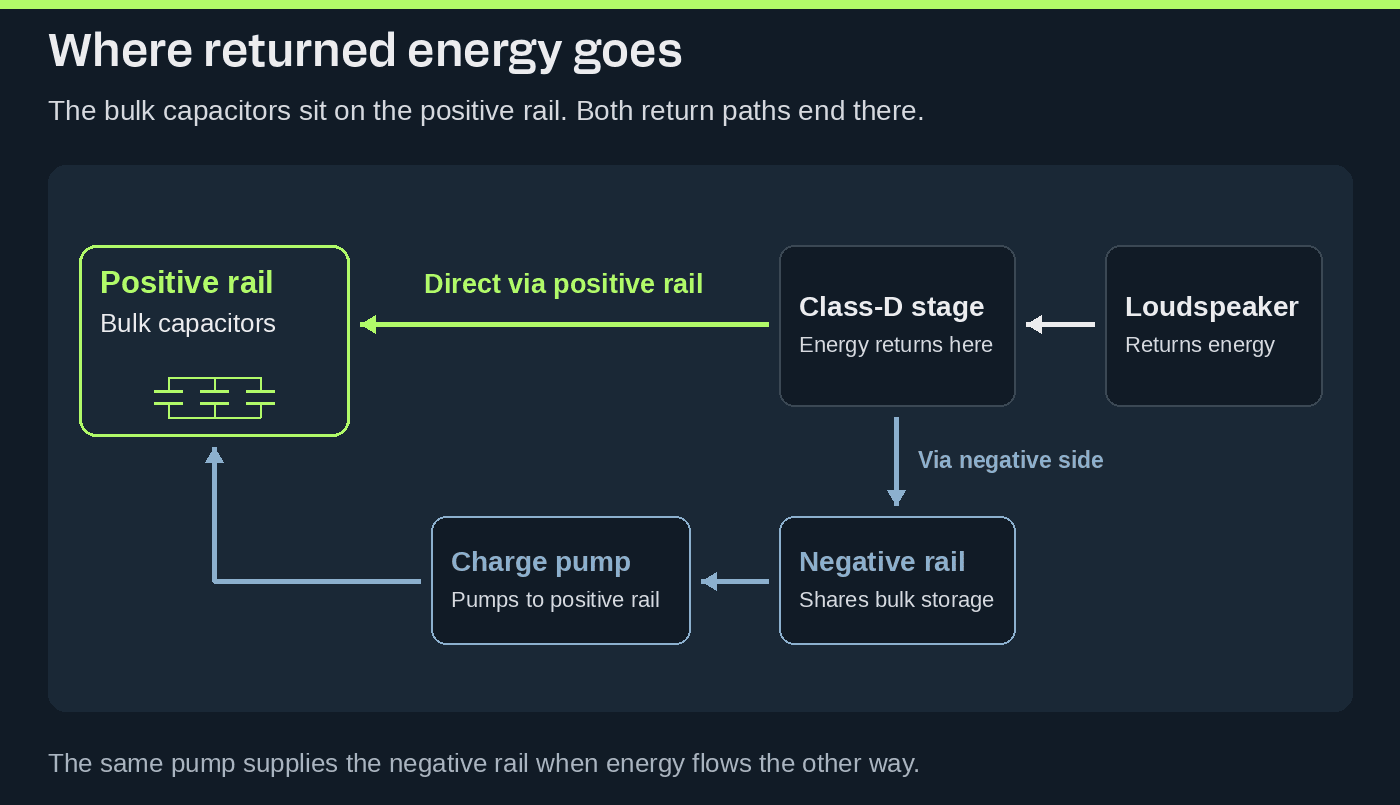
A loudspeaker uses energy from the amplifier to move its cone and make sound. It can also store energy in the motion of the cone and in the magnetic field of the voice coil. As the signal changes, some of that stored energy can flow back into the amplifier.
Why the negative rail has to handle energy in both directions
A rail is a supply voltage inside the amplifier. Our Class-D output stage uses a positive and a negative rail to drive the output above and below zero. The negative rail stays below zero whether it is supplying energy or receiving it.
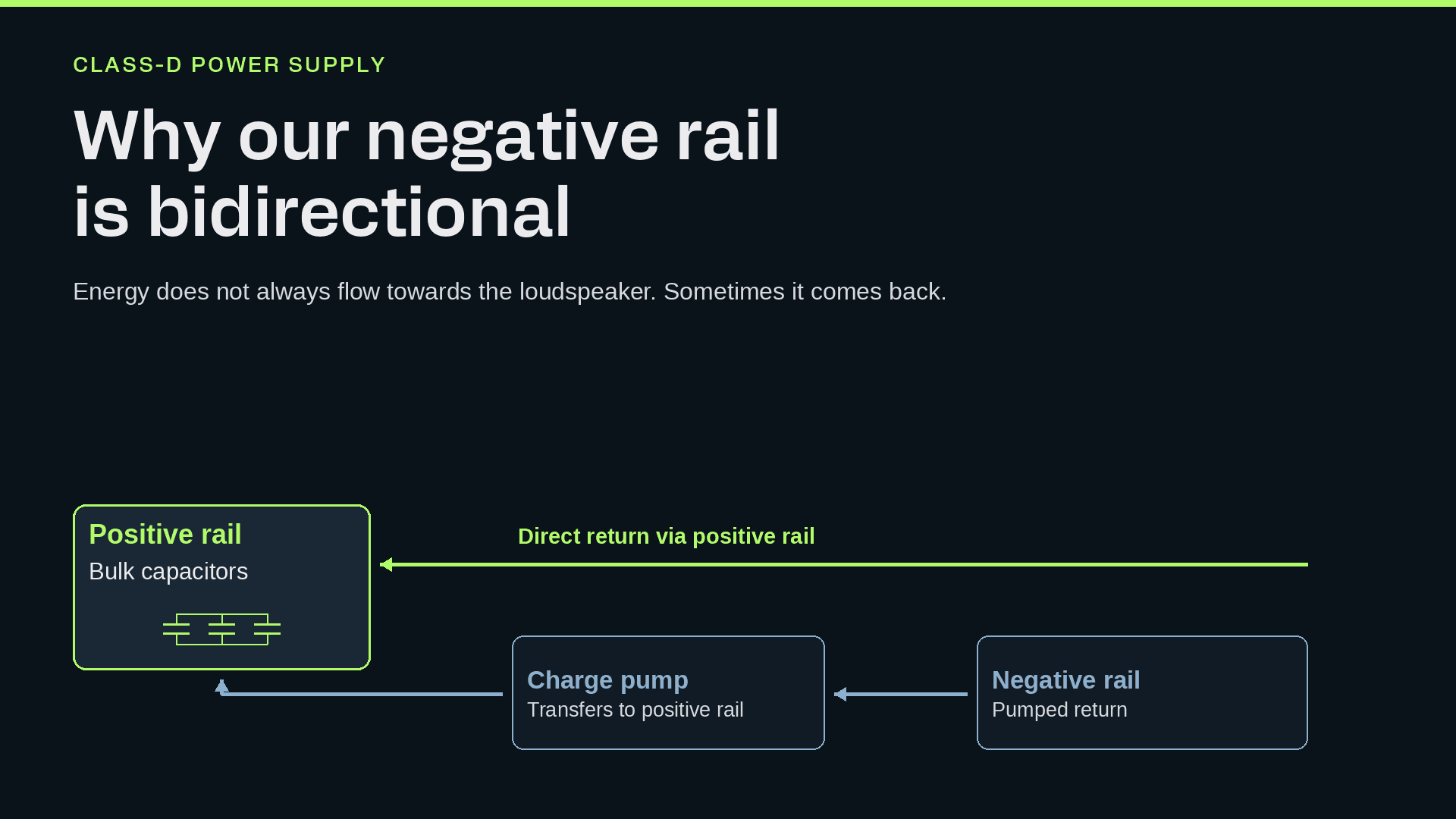
Our bulk capacitors sit only on the positive rail. They are the amplifier’s main energy store. When the loudspeaker feeds energy back through the positive side of the output stage, it goes directly into those capacitors. When it returns through the negative side, the charge pump transfers it from the negative rail to the same capacitors on the positive rail.
How we generate the negative voltage
We use an inductorless charge pump. In one part of the switching cycle, electronic switches charge a capacitor. In another, they reconnect it so it can transfer charge to the negative rail. Repeating this cycle produces the negative supply voltage.
The pump draws energy from the positive rail to supply the negative rail. When the output stage feeds energy back into the negative rail, the pump transfers it in the opposite direction. This helps keep returned energy from building up on the negative side and pulling its voltage farther below zero, an effect called rail pumping.
Why this matters for DC output
Music makes the output voltage swing up and down. Some specialist applications need the amplifier to hold a steady voltage. For example, a steady current through a suitable voice-coil actuator can maintain a constant force. Holding a steady output voltage is a DC output.
A sustained output can load the two supply rails unevenly. A negative rail that can supply and absorb energy helps keep its voltage steady under those conditions. Together with an output stage designed to pass DC, it lets us deliver a steady output when the application needs one.