
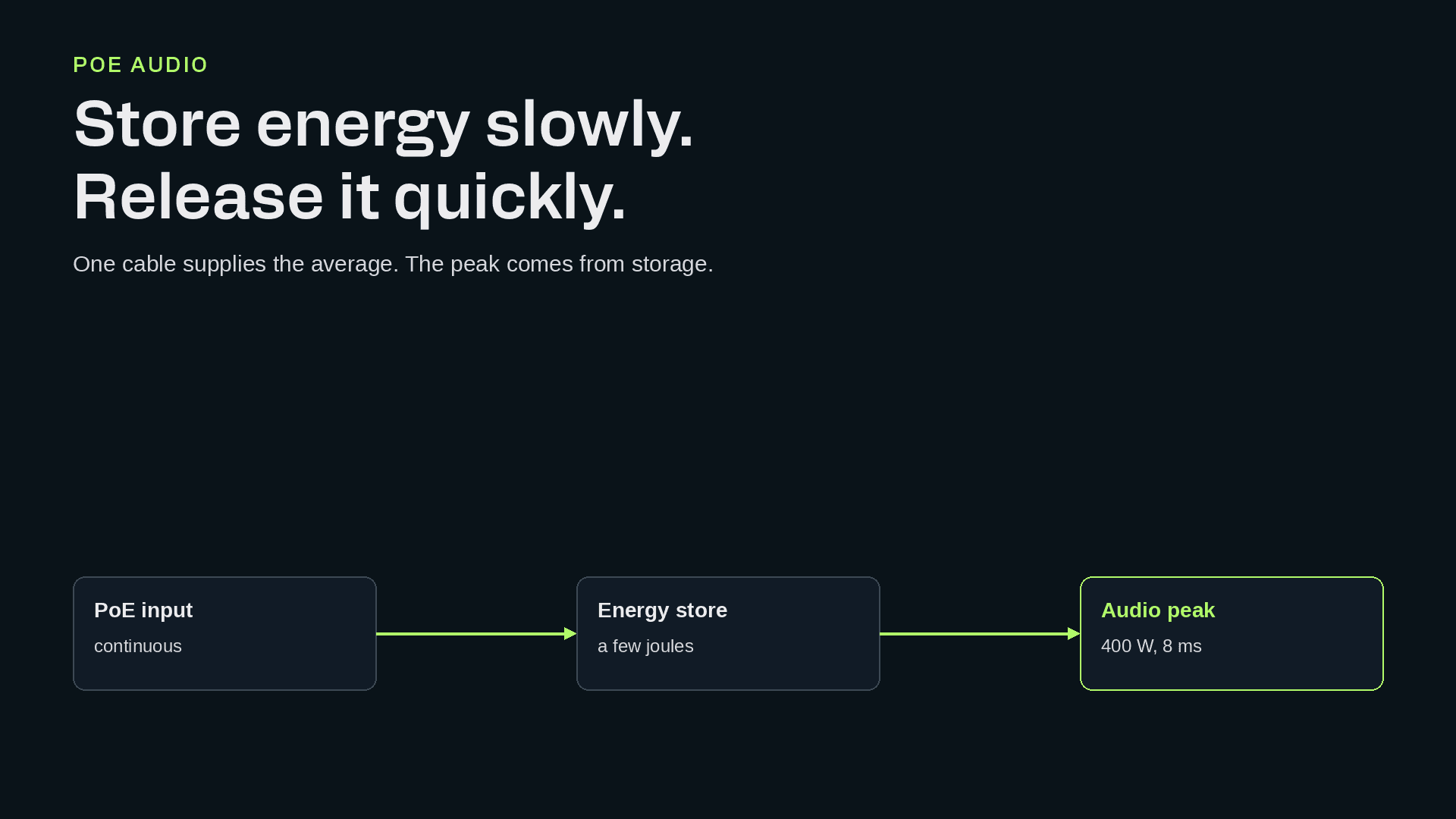
A PoE amplifier can deliver a 400 W audio peak from one Ethernet cable by storing energy and releasing it in milliseconds. The cable supplies the average.
At first sight, the numbers do not add up.
Power over Ethernet can provide only a fraction of the power that a high-performance audio amplifier may need during a loud transient. Yet a PoE-powered amplifier can still produce hundreds of watts of short-term audio output.
How is that possible?
The answer becomes surprisingly simple once we stop looking only at power and start looking at energy over time.
Power tells us how quickly energy is being used. Energy tells us how much has actually been used.
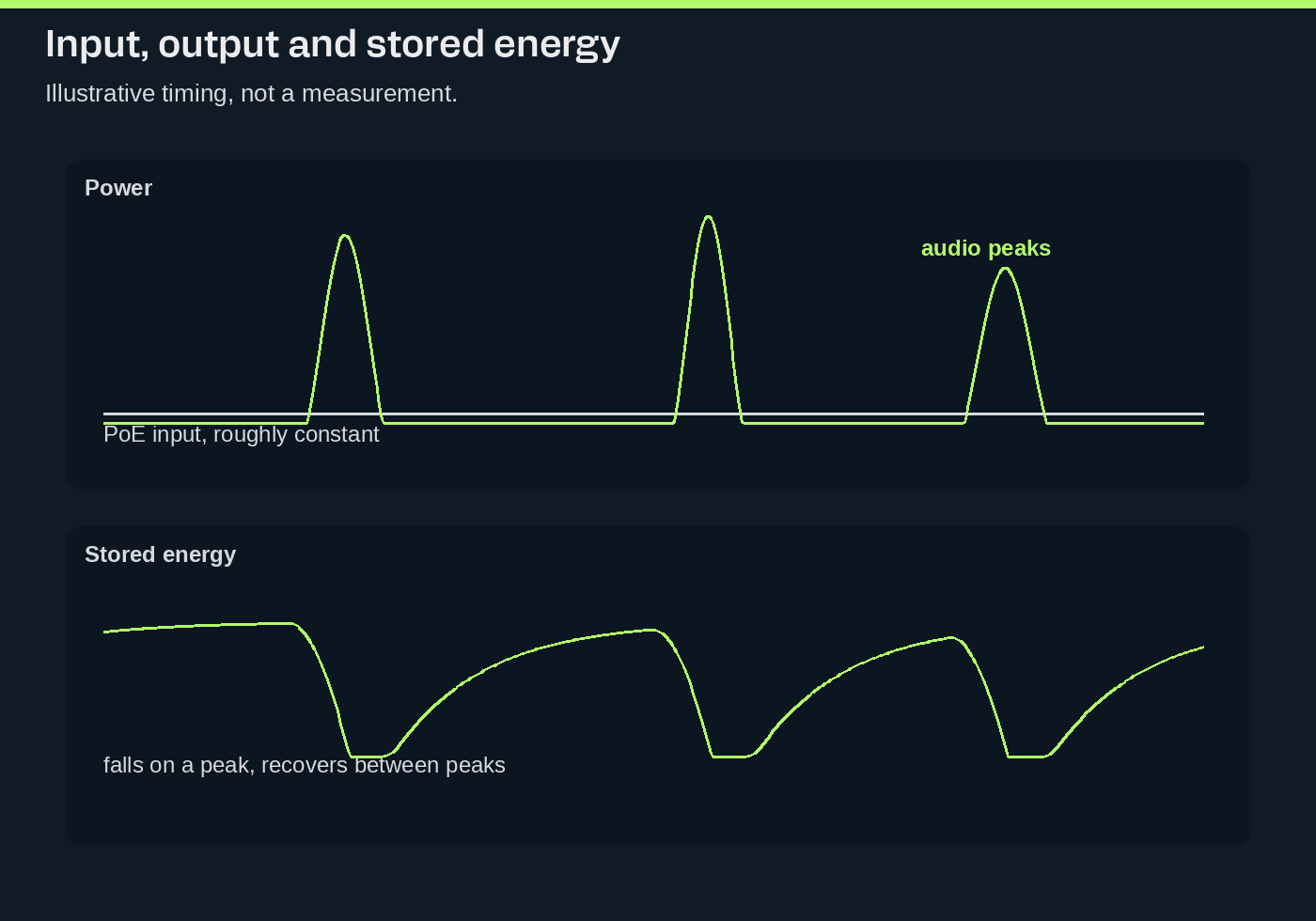
A PoE connection supplies energy continuously. The amplifier stores some of that energy locally and releases it much faster when the audio signal demands a high-power transient.
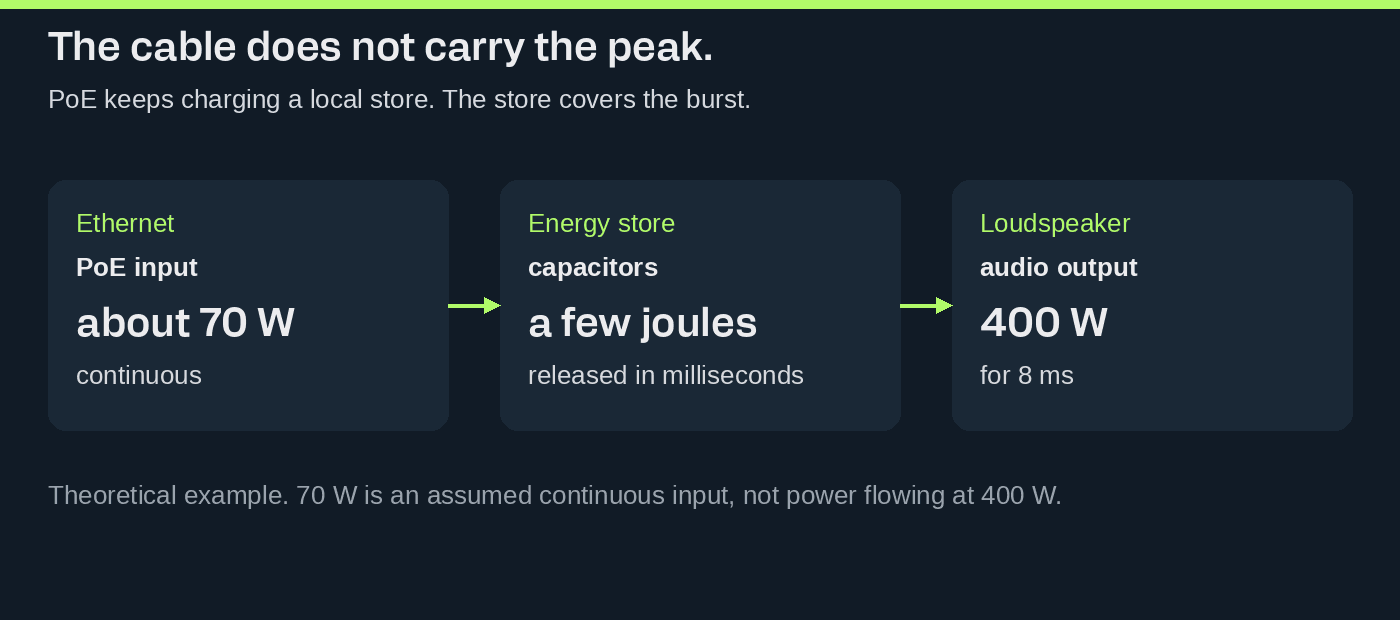
The Ethernet cable does not have to carry 400 W.
It only has to provide enough average energy to keep the local energy store charged.
The apparent contradiction
Let us start with a deliberately simplified example.
Imagine a PoE-powered amplifier that can produce a 400 W audio burst.
Its Ethernet connection cannot continuously provide anything close to 400 W at the amplifier.
That sounds like a contradiction, but it is not.
The important word is continuously.
An amplifier reproducing music does not normally deliver its maximum output power all the time. Audio contains peaks, pauses and quieter passages. This gives us the opportunity to accumulate energy when demand is low and release it when demand is high.
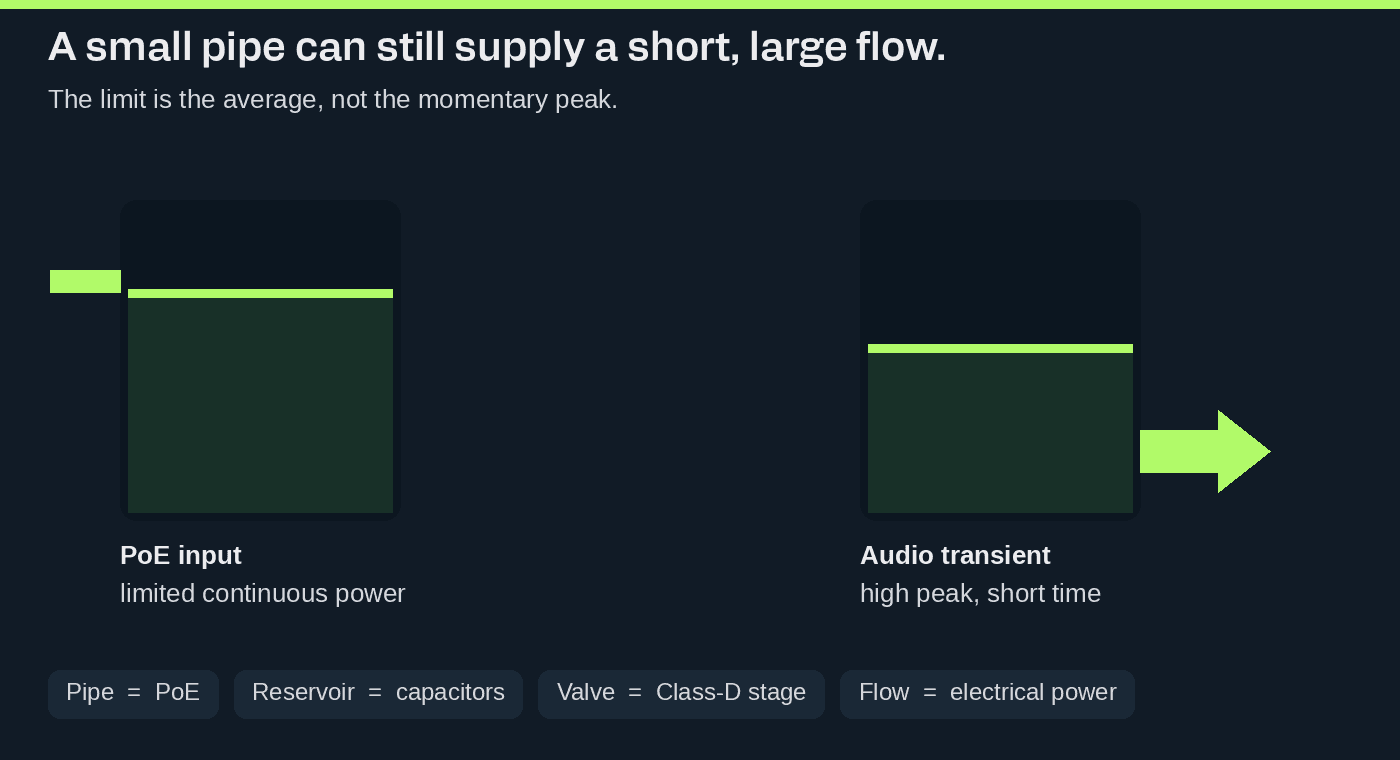
The principle is similar to filling a reservoir from a relatively small pipe.
The pipe might have a limited flow rate, but if the reservoir is sufficiently large, a much higher flow can leave the reservoir for a short period.
For an amplifier:
- the Ethernet cable is the pipe,
- the capacitors are the reservoir,
- and the loudspeaker transient is the short burst of high flow.
Power is not energy
The distinction is easiest to see mathematically.
Energy is simply power multiplied by time:

Suppose our theoretical amplifier delivers 400 W for 8 ms.

That is the first important result.
A 400 W output sounds enormous compared with a PoE power source.
But a 400 W burst lasting only 8 ms represents just 3.2 joules of audio energy.
That is a perfectly practical amount of energy to store in capacitors.
The PoE supply is still working during the peak
The capacitors do not have to provide all of the energy.
The PoE input continues to deliver power while the audio transient occurs.
For a simplified theoretical calculation, assume that about 70 W is available continuously from the PoE source. That is about what a powered device can draw from an IEEE 802.3bt Type 4 port. A basic PoE port supplies far less.
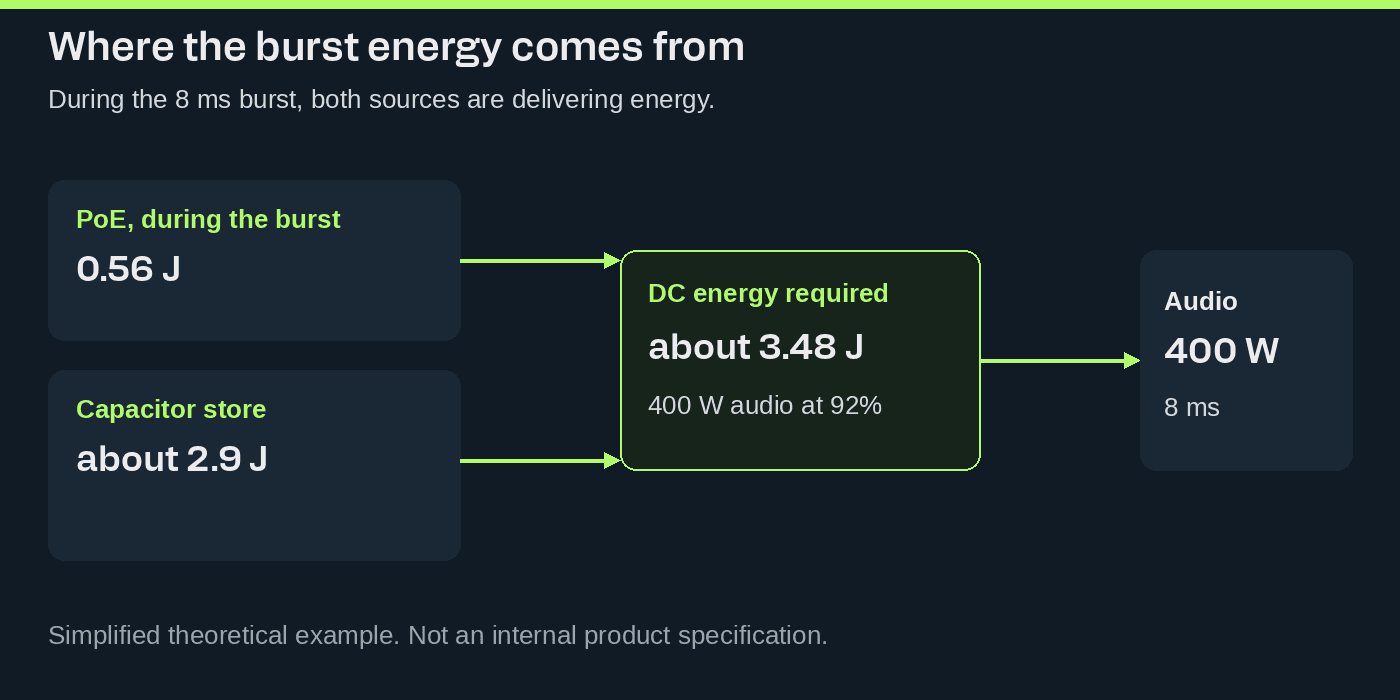
During an 8 ms transient, the PoE source itself contributes:

Now include the efficiency of the amplifier.
Assume a Class-D output-stage efficiency of 92%. Producing 400 W of audio therefore requires approximately:

For an 8 ms burst that is about 3.48 J from the DC side:

The PoE source contributes approximately 0.56 J during the same period. The energy store therefore has to provide roughly:

So our seemingly impossible 400 W amplifier has turned into a much more ordinary engineering problem:
We need to store approximately 3 joules and make them available within a few milliseconds.
That is exactly what capacitors are good at.
How much capacitance would we need?
Now we can estimate the capacitor bank required to store those approximately 2.9 joules.
The energy stored in a capacitor depends on the capacitance and on the square of the voltage. An amplifier would normally not discharge its capacitors all the way to zero volts. If the capacitor voltage falls from a higher voltage to a lower one, only the difference is usable:

Rearranging gives the required capacitance:

Using a theoretical energy requirement of approximately 2.9 J:
- 60 V to 50 V: 5.3 mF
- 60 V to 45 V: 3.7 mF
- 50 V to 40 V: 6.4 mF
- 48 V to 40 V: 8.2 mF
- 40 V to 30 V: 8.3 mF
- 30 V to 20 V: 11.6 mF
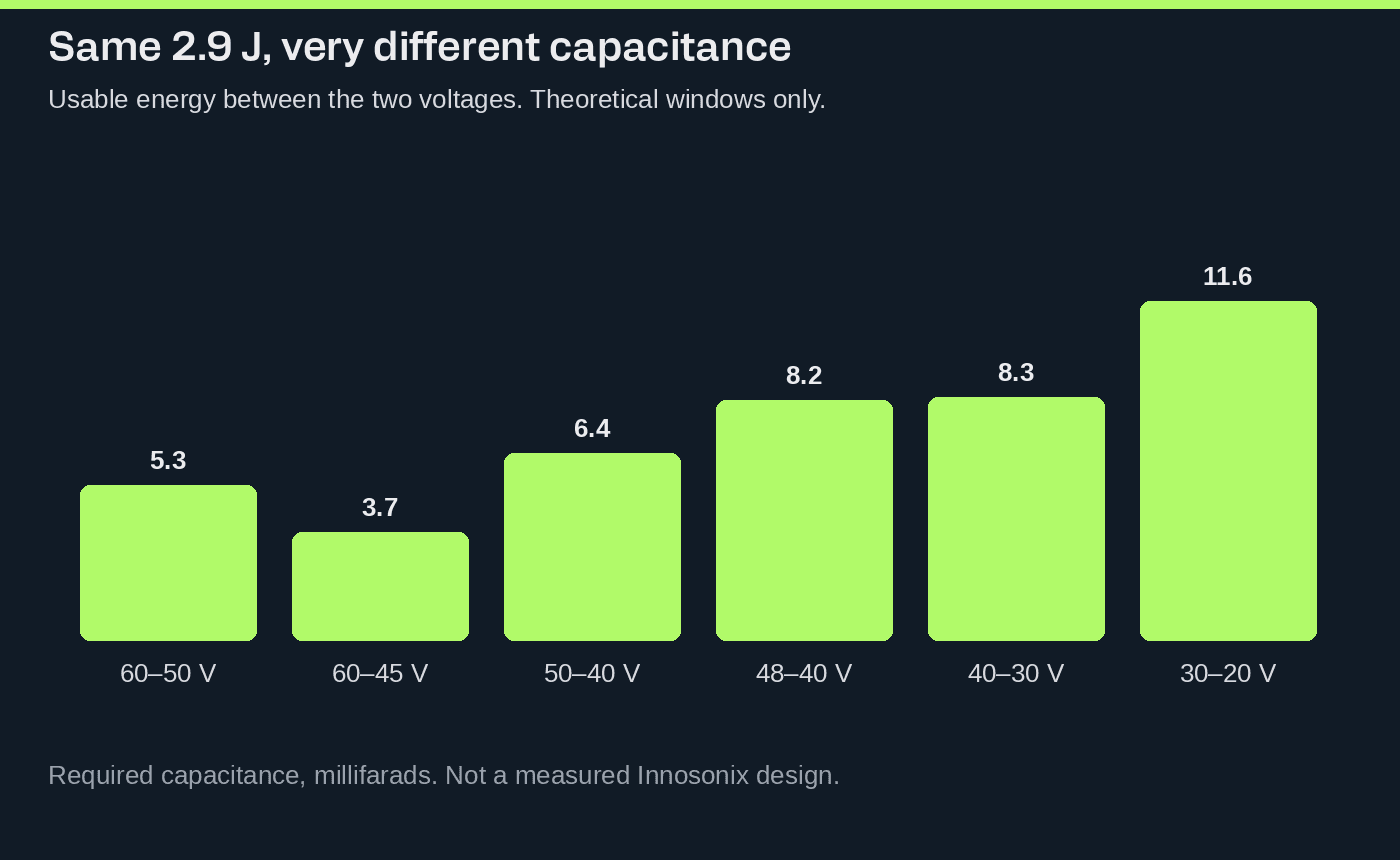
These values are not the design of a particular Innosonix amplifier. They are deliberately simplified examples showing the underlying physics.
But they reveal something important.
Voltage makes a big difference
Capacitor energy increases with the square of voltage.
That means the voltage at which energy is stored has a major influence on the physical amount of capacitance required.
For the same approximate 2.9 J of usable energy:
- a 60 V to 50 V store needs only around 5.3 mF,
- while a 30 V to 20 V store needs around 11.6 mF.
That is more than twice the capacitance, for the same 10 V window at a lower voltage.
This is one reason why the power-supply architecture of a high-performance amplifier matters so much.
Real amplifiers are more sophisticated
The previous calculation deliberately assumes one simple capacitor bank operating between two voltages.
A real high-performance amplifier does not necessarily work like that.
There may be:
- several internal supply voltages,
- dynamically selected voltage rails,
- separate energy stores,
- active power conversion,
- output-voltage-dependent rail selection,
- current limiting,
- power limiting,
- and intelligent management of the available stored energy.
For example, using a high supply voltage all the time would make it easy to generate large output voltages, but it can also increase switching losses and reduce efficiency at low output levels.
Using a lower supply voltage is more efficient for small signals, but does not provide enough voltage for large peaks.
A sophisticated amplifier can therefore operate at different internal voltage levels depending on what the audio signal requires.
This allows it to optimise both efficiency and peak output capability.
The exact implementation is an engineering problem in its own right.
The important point for understanding PoE amplification is that none of these techniques change the fundamental energy balance.
PoE supplies the energy.
The amplifier stores it.
The power electronics make that stored energy available at the voltage and current required by the loudspeaker.
Why audio is particularly well suited to this approach
This architecture works because music is dynamic.
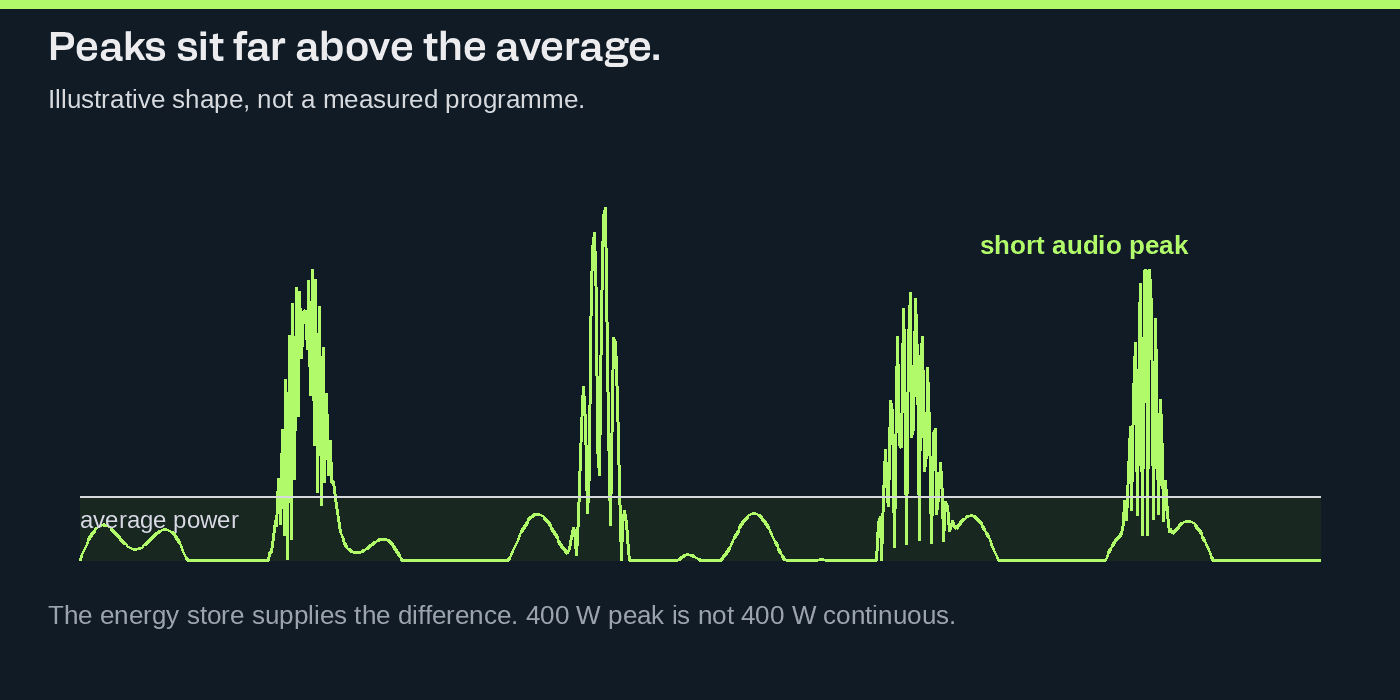
A 400 W amplifier does not normally deliver 400 W continuously when reproducing real programme material.
Audio has a crest factor: the difference between its peak level and its average level.
Consider a signal with a 12 dB peak-to-average power ratio. The corresponding power ratio is about 15.85. If the signal reaches a 400 W peak, its average output power is about 25 W.
At 9 dB the ratio is about 7.94, and the average is about 50 W.

This is the crucial relationship.
The peak power may be hundreds of watts while the average power remains within the range that PoE can support.
The capacitor bank handles the difference between these two time scales.
PoE works over tens of milliseconds, seconds and minutes.
The energy storage handles the milliseconds.
The capacitors have to recharge
Energy storage does not make the input-power limit disappear.
It shifts the limitation in time.
Suppose an audio transient removes approximately 3 J from the energy store.
With 70 W available from PoE, even an ideal system would need about 43 ms to replace that energy:

In reality, the recharge time is somewhat longer because:
- the amplifier itself consumes some power,
- power converters have losses,
- and the audio signal may continue to require energy while the capacitors are recharging.
This defines the fundamental boundary of the system.
A PoE-powered amplifier can produce output power far above its input power for short periods.
It cannot produce that power indefinitely.
If the average output demand remains above the available input power for long enough, the stored energy will eventually be depleted.
At that point, an intelligent amplifier has to reduce the permissible output power.
There is no way around conservation of energy.
And there does not need to be.
The real engineering challenge
Once the basic energy calculation is understood, the interesting part is no longer whether high peak power from PoE is possible.
It clearly is.
The interesting questions become:
- How much energy should be stored?
- At what voltage should it be stored?
- How quickly may the storage voltage change?
- How much peak current must the capacitors deliver?
- How should the energy store be recharged?
- How should different internal supply voltages be selected?
- How should the amplifier behave when the energy reserve is becoming depleted?
- How can all of this be achieved efficiently in a compact product?
Those are the challenges that turn a simple capacitor calculation into a real amplifier.
So where do the 400 watts come from?
Ultimately, exactly where every watt has to come from: previously supplied energy.
The Ethernet connection supplies energy continuously.
The amplifier stores part of that energy locally.
When a loud transient arrives, the output stage draws simultaneously from the PoE source and the local energy store.
The instantaneous output power can therefore be many times higher than the instantaneous power entering through the Ethernet cable.
After the transient, the capacitor bank is recharged.
Nothing is multiplied.
Nothing is created.
The energy has simply been moved through time.
That is the central idea behind high-power PoE audio:
PoE determines how quickly energy enters the amplifier. Energy storage determines how much can be accumulated. The output stage determines how quickly it can be delivered to the loudspeaker.
Once power, energy and time are considered separately, delivering a 400 W audio peak from a single Ethernet connection is no longer a contradiction.
It is an energy-management problem.
And that is exactly what makes it interesting engineering.
Want to see what this looks like in a real amplifier? Explore the μMA01/PoE.